Entertainment against alternatives
“Steal”, the Epstein Class, and the Caricaturing of Resistance Leaders
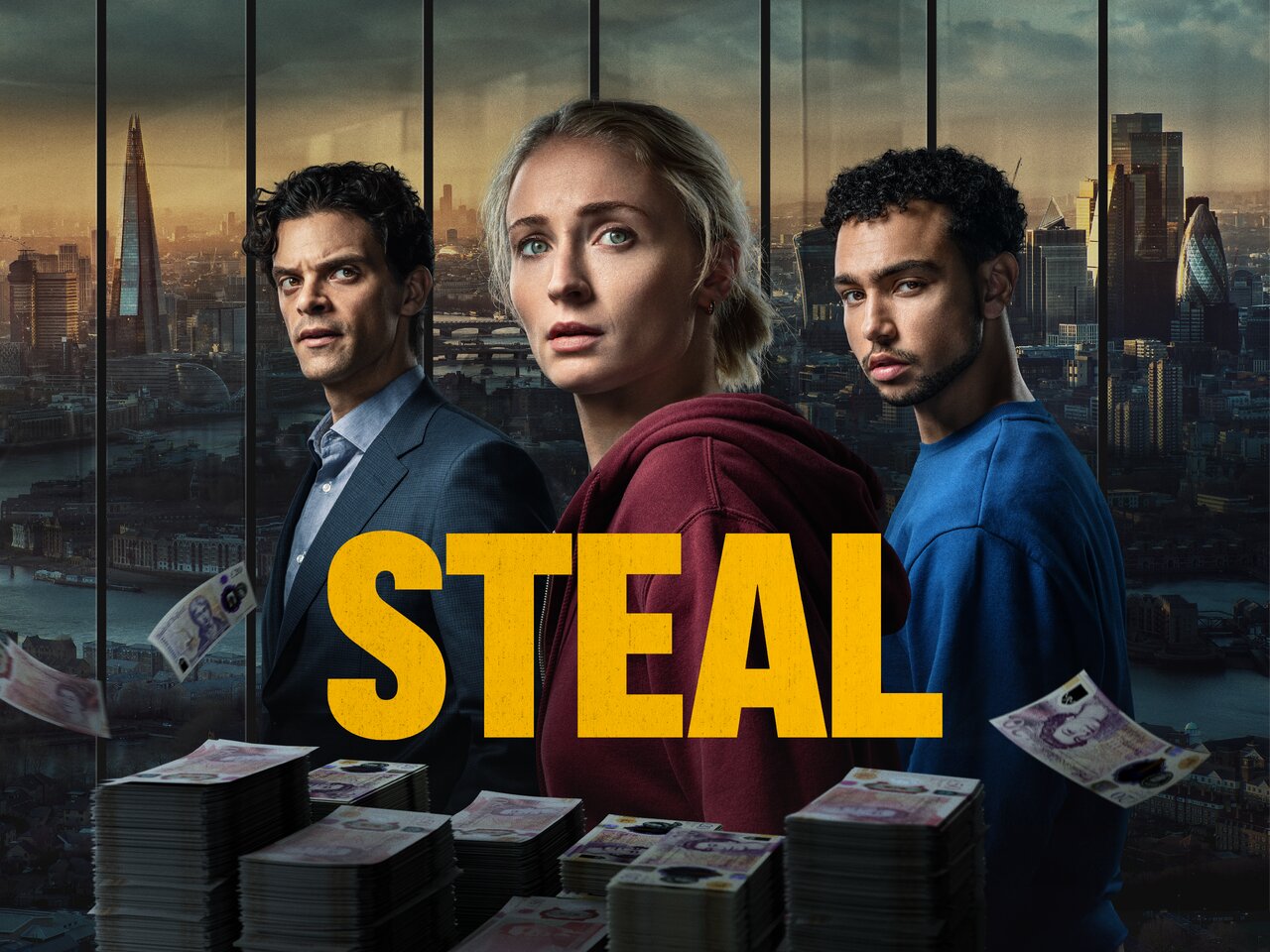
TEHRAN- On the surface, “Steal” is a crime-thriller miniseries about the “heist of the century” and financial corruption—a seemingly anti-capitalist text alert to inequality. Yet the ultimate layer of its message shores up the same war-driven capitalist order: it hides the Epstein class behind a sacrificial body and absolves that class by killing him; normalizes the war broker; caricatures the resistance’s intellectuals and defense leaders in the figure of Darren Yoshida; and leaves individual theft as the only rational horizon.
Meaningful Haste
The project was announced in May 2024 under the title “Haven,” and filming began in London that same month. Its creator, Sotiris Nikias, had written crime novels under the name Ray Celestin but had no previous experience as a television screenwriter. Nevertheless, for his debut, Amazon and Drama Republic brought in Sam Miller and Hettie Macdonald as directors and placed Sophie Turner at the head of the cast—a global star who had emerged from “Game of Thrones,” surrounded by a largely television-based and considerably less prominent ensemble. Turner has said that she met with Sam Miller after reading the script. Her route into the project was not Nikias’s reputation but the industrial package assembled by Amazon, the production company, and the director. The function of her presence is clear: to lend credibility, marketability, and promotional power to a text that conceals its principal message until its final minutes.
Israel’s war against Iran began on June 13, 2025, and the United States entered it directly a week later. Months afterwards, the series’ final title, official images, and release date were announced, and it premiered on January 21, 2026. This interval, together with the work’s final construction, lends significance to the haste discussed below.
Yoshida is present from the beginning, yet he is granted almost no human presence: he forms no relationships, advances no conflict, and acquires neither a past nor a personality. Throughout the first five episodes, evil is distributed among Milo, Gould, the mercenaries, MI5, and the financial network. Then, within the final few minutes, all these paths are abruptly abandoned, and Yoshida becomes both the architect of the entire operation and the bearer of a political manifesto. It is as though the original antagonist had been removed and a new mission grafted onto the body of a marginal financial investigator—a mission that has also effaced the original role of this supporting character.
The Epstein Class and the Individual Body
The “Epstein class” is not the name of the small circle surrounding Jeffrey Epstein. It is a transnational class at the heart of the global order, linking politicians, capitalists, bankers, war brokers, military figures, media operators, and celebrities through a shared network of money, bodies, war, and entertainment. The Epstein case was the emblematic condensation of this class: a single body was placed at the centre of the scandal, removed through an ambiguous death, and the principal network remained intact.
Milo Carter-Walsh plays the same role in Steal. He is the only comparatively fleshed-out embodiment of this class: endowed with money, connections, and access, with no need for money and a taste for villainy wherever the risks can be calculated, yet without his actions ever being named with moral clarity. He is then killed and presented as a middle-ranking mastermind behind the heist. Milo’s corpse absorbs the audience’s moral outrage, allowing the financial, political, security, and war-making network behind him to recede from view. The body is sacrificed; the class remains.
Gould: Whitewashing the War Broker
Sir Toby Gould, the head of an arms company and a broker of war, is the series’ tacit, embodied representative of Israel and the clearest member of the Epstein class within it. Yet the text does not place him at the center of its moral corruption. The stolen money reaches accounts connected to him; he is questioned, produces a few documents, and withdraws from the story. Peter Mullan’s imposing presence gives him power, reality, and brazenness, but the narrative is not organized against him. The war broker, with his fabulous wealth and hidden networks, becomes a natural part of the world.
Elsewhere, the MI5 official played by Anna Maxwell Martin intimidates Zara in a brief scene, threatens her with counter-terrorism legislation, and effectively forces her to choose between the police and the security apparatus. Even in an appearance lasting only a few minutes, the state is endowed with character, authority, and agency. Gould has character too. Milo has a body. The only alternative—the revolutionary Yoshida—is neither made into a character nor even completed as a type.
Yoshida: The Resistance Leader as Caricature
In a sloganistic, fleshless voice, Yoshida speaks of millions of people going hungry, tax havens, and a system that does not work for ninety-nine per cent of the population. His language is close to the intellectual tradition of David Graeber and Yanis Varoufakis. His mode of action also recalls leaders of resistance, defence, and revolution: long-term planning, a clandestine network, infiltration of the enemy’s structures, indirect command of operations, and the creation of a patient, parallel infrastructure. The laptop that houses a virtual bank is a condensed image of Gaza’s tunnel-based sovereignty: an alternative, hidden, and mobile order that must survive under pressure from a more powerful force.
Steal combines radical thinkers and resistance leaders in Yoshida and then condemns him without even taking the time to make him into a character worth taking seriously. Rhys calls him juvenile, naïve, and responsible for the deaths of others, while Zara rejects both his project and his money. The message is clear: do not trust Graeber, Sinwar, Nasrallah, or Iran’s martyred leader; anyone with a plan to change the world is, at best, delusional and, at worst, a maker of victims.
The Ending: Individual Theft, Yes; Collective Transformation, No
The ending completes the series’ ideological apparatus. Zara and Rhys reject Yoshida’s £10 million because accepting it would mean joining his project. Moments later, Zara produces Milo’s £20 million, and the two decide to begin their “exciting” lives with this “clean” money. The problem, then, is not the money’s dirty provenance; it is the money’s connection to collective action. Money used to change the existing order is contaminated, while the same money used for personal escape becomes the hero’s reward.
At the level of slogans, “Steal” speaks against corruption; at the level of characterization, it caricatures the resistance leader and the anti-capitalist thinker; at the structural level, it keeps the war broker and the security apparatus normalized and powerful; and at the ethical level, it substitutes individual theft for collective transformation. Its final message is simple: do not change the world, do not trust alternatives, take your share, and walk away. This is the moment when anti-corruption entertainment becomes soft propaganda for the Epstein class.
Leave a Comment